How to Start a Project When You Have No Motivation
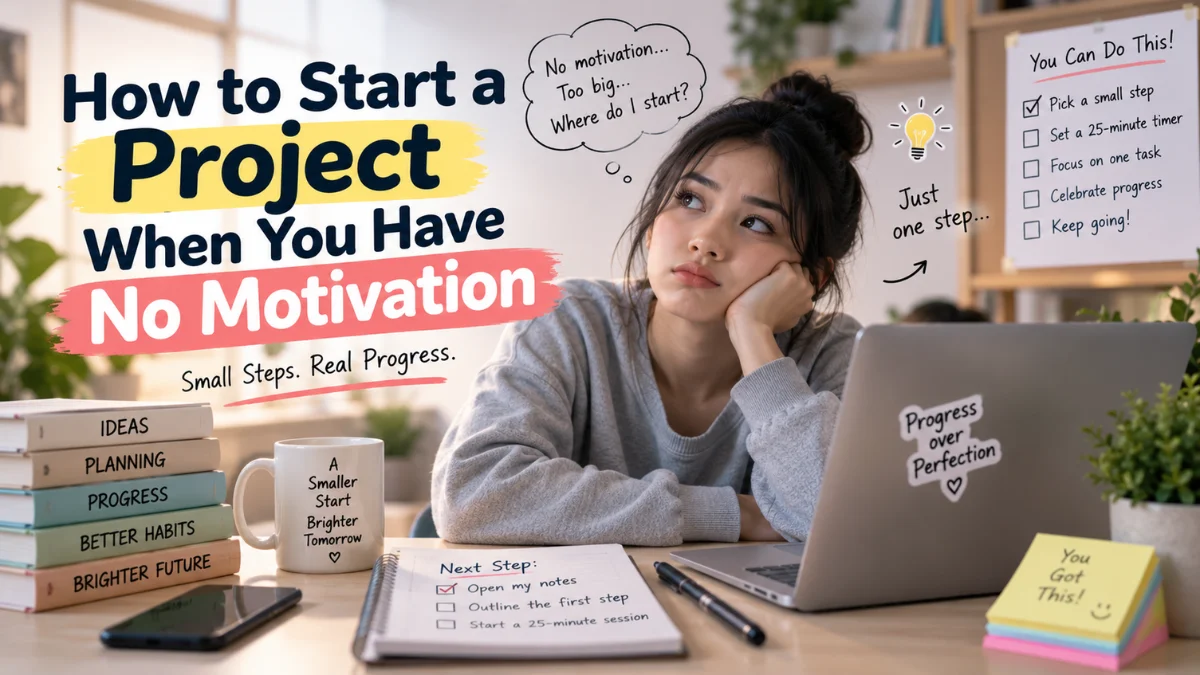
The project sits open. The deadline is real. Motivation is nowhere. Most advice says “just start,” which is true and useless until you know how. This guide on how to start a project when you have no motivation gives a concrete loop: shrink the first step, run a short timer, protect focus for one block, then celebrate progress small enough to repeat tomorrow.
Quick answer: How to Start a Project When You Have No Motivation — pick one tiny next step (open the file, write three bullets, outline the intro), set a 25-minute timer, work only that step, then stop and note what you finished. Motivation usually follows the first small win; it rarely arrives before you begin.
Why motivation is a terrible starting requirement
Motivation is a feeling. Projects are work. Waiting to feel ready keeps the task huge in your head — “too big… where do I start?” — which makes avoidance feel rational. Action shrinks the threat. After ten honest minutes, the project is no longer a fog; it is a document with a title and a next line. That shift is why staying motivated while studying is built on habits and short wins, not pep talks alone.
Step 1 — Make the project smaller than your fear
Write the full project name once, then ignore it. Under it, write only the next physical action:
- Open my notes / create the doc
- Outline the first section in three bullets
- Find one source or past paper question
- Write the ugly first paragraph without editing
If the step still feels heavy, cut it again until it feels slightly silly. Silly starts beat noble stalling. This is the same shrink-the-task move from how to stop procrastinating studying.
Step 2 — Set a 25-minute timer (progress over perfection)
Open StudentTimer and run one Pomodoro on that tiny step only. You are not finishing the project in 25 minutes. You are buying proof that movement is possible. Perfectionism dies in short blocks because there is no time to polish — only to produce. For the classic method, see the Pomodoro technique for students; if 25 still feels long, start at 10–15 and step up later ( 25 vs 50 minutes).
Step 3 — Focus on one task, not the whole mountain
During the block, the only allowed work is the sticky-note step. No “quick” reorganization of your whole folder. No redesigning the plan. If a new idea appears, park it in a “later” line and return to the step. Clear the phone and extra tabs so the block is not a distraction contest — study without distractions and how to focus while studying.
Step 4 — Celebrate progress (then decide on a second block)
When the timer ends, write one sentence: what you finished. Check the box. That micro-celebration trains your brain that starting pays. Optionally run a second Pomodoro if energy rose. If not, stop while ahead — a finished small start beats a heroic plan you abandon at midnight. Consistency compounds; burnout does not.
A five-minute “no motivation” starter script
- Name the fear (10 sec): “Too big / don’t know where to start.”
- Write one next step (1 min) on paper or at the top of the doc.
- Clear one distraction (1 min): phone away, one tab.
- Start StudentTimer (25 min or less) on that step only.
- Log the win (1 min): check the box; note tomorrow’s next step while it is obvious.
For study projects vs creative or group projects
Essays and assignments
First step is rarely “write the essay.” It is “thesis in one sentence” or “three supporting points.” Outline under time, then draft one ugly paragraph in the next block.
Exam revision projects
First step: one topic blurt or five flashcards — not “revise the whole unit.” Tie starts to active recall so the block produces learning, not guilt.
Group or multi-week projects
First step: message the team one concrete ask, or block 25 minutes on your piece only. Waiting for group motivation multiplies delay.
What not to do when motivation is missing
- Wait for the perfect mood: mood follows motion
- Rebuild the whole plan instead of starting: planning becomes procrastination
- Compare your start to someone else’s highlight reel: your only race is the next step
- Open social feeds “for a minute”: that minute eats the block
- Aim for a masterpiece in block one: aim for a messy start you can improve
If timers keep failing for other reasons — breaks, task size, distractions — troubleshoot with Why Isn't the Pomodoro Method Working for Me?
Frequently asked questions
How do I start a project when I have no motivation?
Shrink the project to one tiny next step, set a short timer (often 25 minutes), work only on that step, then stop and note what you finished. Motivation usually follows the first small win instead of arriving before you begin.
Why do I wait for motivation before starting?
Big, unclear projects feel threatening, so the brain delays. Waiting for inspiration keeps the project huge. A smaller start lowers the threat and creates proof that progress is possible.
How small should the first step be?
Small enough that starting feels slightly silly — open the document, write the title, outline three bullets, or complete one practice question. If you still stall, make it smaller again.
Does a Pomodoro timer help when motivation is low?
Yes. A timed block turns “work on the whole project” into “stay with one step until the bell.” That container is often enough to begin when motivation is missing.
Next step: Open StudentTimer, write one ridiculous-small next step for the project you are avoiding, and run a single 25-minute Pomodoro on that step only. Check the box when you finish — that is how projects start without motivation.