25 Minutes vs 50 Minutes: Which Pomodoro Length Works Best?
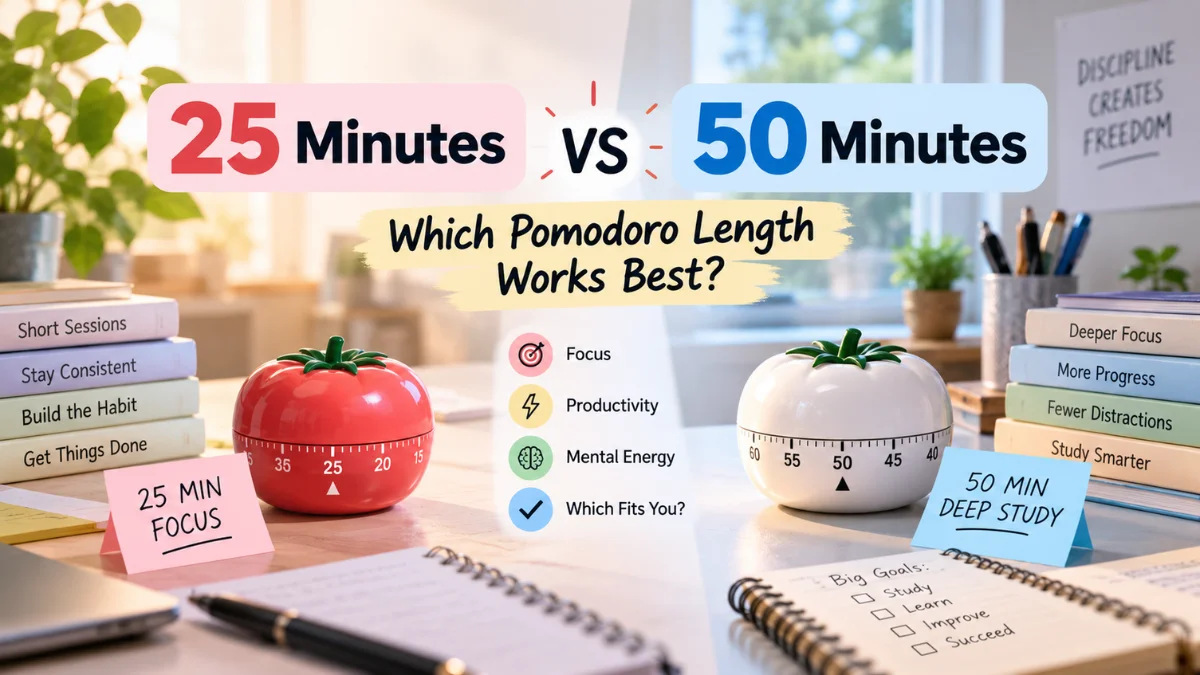
Students argue about timer length as if one number wins forever. It does not. The real question — 25 Minutes vs 50 Minutes: Which Pomodoro Length Works Best? — depends on the task, your focus stamina, and whether you need a habit you can start or a block deep enough to finish hard work. This guide compares both lengths and shows when to use each inside StudentTimer.
Quick answer: 25 Minutes vs 50 Minutes: Which Pomodoro Length Works Best? Use ~25 minutes to start consistently, stay consistent, and handle smaller or mixed tasks. Use ~50 minutes (Deep Study) when you need deeper focus and fewer interruptions for essays, problem sets, or coding — then take a slightly longer break.
What “25 vs 50” really means on StudentTimer
On StudentTimer, the classic short block is Pomodoro-style focus (about 25 minutes) with a short break. The longer option is Deep Study (about 50 minutes) for work that should not be chopped mid-thought. Both are timed focus + recovery. Neither replaces clear tasks or a phone-away setup — if short sessions keep failing for other reasons, read Why Isn't the Pomodoro Method Working for Me? first.
When 25 minutes works best
Short sessions win when the hard part is starting, not enduring. They lower the cost of beginning, fit between classes, and make it easier to stay consistent across a week. They also suit mixed revision: flashcards, cue quizzes, one past-paper question, or a single blurting dump.
- Build the habit: finishing a block matters more than heroic length
- High resistance days: a small container beats waiting for motivation
- Shallow-to-medium tasks: email-to-self summaries, definitions, light practice
- Energy dips: late nights when 50 minutes would turn into zoning out
Pair 25-minute blocks with the structure in the Pomodoro technique for students guide and keep breaks honest — about five restorative minutes, not a scroll trap ( break length guide).
When 50 minutes works best
Longer blocks win when interruption costs more than endurance. Warm-up alone can eat 10–15 minutes on a hard problem; ringing a bell at 25 then resets that progress. Deep Study suits essays, multi-step maths, lab write-ups, coding features, and dense chapters once you can already sit and start.
- Deeper focus: one thread of thought without restarting
- More progress per sitting: fewer context switches
- Fewer artificial stops: finish a section before the break
- Study smarter on hard tasks: length matches cognitive demand
Protect a 50-minute block like a meeting: phone away, one task, door closed if you can. See deep work for students and study without distractions. After ~50 minutes, take about 10 minutes to reset before another deep block.
Side-by-side: focus, productivity, and mental energy
Focus
25 minutes trains attention in short bursts — ideal while building focus skill. 50 minutes assumes focus is already online and rewards protecting it. If you lose the thread at minute 12 every time, length is not the first fix; task clarity and distractions are.
Productivity
Short blocks maximize completed starts and daily consistency. Long blocks maximize progress on complex work. A “productive” day often mixes both: two short Pomodoros for admin and recall, one Deep Study for the hard assignment.
Mental energy
Longer is not always harder — the wrong length is harder. Forcing 50 minutes when you are fried creates fake studying. Forcing only 25 minutes on a proof that needs ramp-up creates false stops. Match length to energy using how long you should study for and your best hours from best time to study.
A simple decision rule
- Starting feels heavy? Use 25 minutes (or even 15) with one tiny task.
- Already in flow on hard work? Use 50 minutes Deep Study.
- Mixed light tasks? Stay on 25-minute Pomodoros.
- One big deliverable? Prefer 50, with a clear stopping point at the end.
- Unsure? Start 25; if you hit flow and resent the bell, switch the next block to 50.
Sample day that uses both
- Pomodoro (25): closed-book recall or flashcards
- Break (5)
- Deep Study (50): past-paper section or essay draft
- Break (10)
- Pomodoro (25): fix gaps from the deep block
That pattern keeps habit and depth in the same afternoon — and answers “25 Minutes vs 50 Minutes: Which Pomodoro Length Works Best?” with “both, on purpose.”
Common mistakes when choosing length
- Always 50 because it sounds serious: unfinished blocks kill consistency
- Always 25 out of loyalty: you chop work that needed continuity
- Changing length every ten minutes: decide before you start
- Ignoring breaks after long blocks: the next deep session collapses
- Timing passive re-reading: length will not save empty methods — use active study inside the block
Frequently asked questions
Is 25 minutes or 50 minutes better for Pomodoro?
Neither is always better. Use about 25 minutes to start consistently, build the habit, and handle mixed or smaller tasks. Use about 50 minutes (Deep Study) when the work needs unbroken thinking — essays, problem sets, coding, or deep reading — and your focus is already stable.
Can I mix 25-minute and 50-minute sessions in one day?
Yes. Many students warm up with a 25-minute Pomodoro, then switch to a 50-minute Deep Study block for harder work, and return to shorter blocks when energy drops. Match length to the task, not to a single rule for the whole day.
How long should breaks be after 25 vs 50 minutes?
After a 25-minute focus block, about 5 minutes is enough for most students. After a 50-minute Deep Study block, about 10 minutes helps more. Keep breaks restorative — stand, stretch, water — not social feeds.
What if 25 minutes feels too short and 50 feels too long?
Try 30–40 minutes as a middle ground, or start at 15–20 minutes when resistance is high and step up once starting gets easier. The best length is one you can finish and repeat.
Next step: Open StudentTimer, pick today’s hardest task, and choose deliberately: 25 minutes if you need a clean start, 50 minutes Deep Study if you need depth. Run one honest block, then decide which length earned the next one.